


09 FEBRUARY 2026
Understanding and expressing emotions is a key part of early childhood development. In this article, Konstantina Ossa, Senior Speech and Language Therapist from our Group, explores how body language, facial expressions, and simple gestures like pointing help children recognise their own feelings and understand others. She also offers practical strategies for adults to model and reinforce these essential non-verbal communication skills during everyday activities such as play, reading, and interaction.
6 minute read
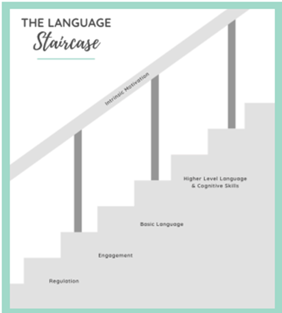
Jessie Ginsburg spoke about the Language Staircase, which outlines the importance of regulation, engagement, and cultivating the children’s interests to support language development. Children’s language development can also be represented as a staircase. The first two steps of the staircase are regulation and engagement. If a child is dysregulated and they are not engaged or motivated in an activity, it is like the first two steps are missing. This means that basic language, higher-level language, and cognitive skills are much more difficult to reach.
Intrinsic motivation is the banister that supports children to reach higher levels of language. This means that language development occurs better when children engage with activities that are driven and inherently motivated by them.
Sensory regulation
For children to better focus, listen, and be able to learn language, it is important that they feel calm, safe and well-regulated. A child that does feels dysregulated, tired, overwhelmed, hungry, upset, or stressed may focus all their energy to cope with these feelings, which makes listening, learning, and communicating more difficult. Regulation lays the foundation for attention, interaction, connection, and learning, which are important for language development.
Embrace their interests
Children better develop their language skills when this is related to what they are truly interested in. Talking about their interests, favourite toys, and activities is easier to capture their interest and attention, which increases their interest and motivation to respond and learn more.
This is particularly important when thinking of children who may not use speech or are learning how to use alternative ways to communicate.
Follow their lead
Let the children lead and show what they like. We do have the tendency to correct, change or show them how to play and do things the right way. It is important to take time and understand how they make sense of the world
Ask fewer questions
We often think that questions are important to connect with or understand what the children know. Instead of asking questions, make comments.
For example, instead of saying?
- Who is this?
- Where is the teddy?
- What colour is it?
Say:
- It’s the bear.
- The teddy is in bed.
- It’s a red ball.
Visuals
Use of visuals (pictures, drawings, symbols) supports the development of receptive (language we understand) and expressive language (things we communicate to others).
How to use visuals
Show them a picture when you give an instruction. This can help children process spoken instructions better and respond to the instructions quicker. For example, you can show a symbol that represents “food” (you can draw this on a piece of paper or a whiteboard to indicate that it is lunch time.
Use visuals around the house to name places or items. For example, have a toilet symbol outside the toilet door and point to it every time the child is going to the toilet. You can also use food menus and shopping lists.
Use visuals to create a timetable or a “now and next”. Both support children understand what the are expected to do. Teach them how to use visuals before you expect them to use them independently.
Modelling
Self-talk
Self-talk is when you talk through what you are doing while doing it. For example, talking through the steps of washing your hands while you are doing it, and the child is around. It is said that parents who talk as they go about their everyday activities expose their child to 1000 to 2000 words per hour.
Parallel talk
Parallel Talk is a way of modelling language by describing what a child is doing. You comment on their actions, for example, if a child is putting on shoes, you might say, “I can see you are putting on your shoes,” or if they are painting, “You used your markers to paint a sunset.” You can adjust the level of language to match the child’s ability, simplifying to “You are painting” or even just “Painting” for younger children or those with emerging language skills.
Expanding
Expanding means to add onto what the child said. For example, if they say “sunset”, you can say “beautiful sunset”, or if they say “lion”, you can say “big lion” or “scary lion”.
Recasting
Recasting is to repeat what the child said while giving them a correct version. For example, the child says, “look at sky blue,” and you say “look at the blue sky”, or if they say “Flowers red,” you can say “the flowers are red”.
Body language and facial expressions
Body language and facial expressions help children understand and express their feelings, emotions, and intentions. Simple gestures, like pointing, teach them to direct attention, while reading facial expressions helps them understand how others feel. To support these non-verbal skills, explain what they see and how you feel, for example, “I am smiling, I am happy.” Do the same for others or characters when watching TV or reading books, and use books and toys to point to during play or reading. You can also model pointing when they are reaching for items that are out of reach.