
24 hour Referral Line: 0800 304 7244

Using Assess, Plan, Do, Review To Support Learners With EBSA

28 SEPTEMBER 2026

This article, written by Dr Lauren Bowden, Educational Psychologist from our Group, aims to support professionals working with EBSA by providing a clear framework and process to guide their practice.

Emotion Based School Avoidance (EBSA) is a term used to describe children and young people who experience difficulty attending school due to emotional factors, often resulting in prolonged absences. Thambirajah et al. (2008) defines EBSA as: “…occurs when stress exceeds support, when risks are greater than resilience and when ‘pull’ factors that promote school non-attendance overcome the ‘push’ factors that encourage attendance”.

Some prefer to use the term Emotion Based School Non-Attendance (EBSNA) or Pupils who Can’t Attend School Currently (CASC). These terms can enable curiosity about the circumstances in which a child may not attend and avoids the idea that the young person has control over non-attendance or that the ‘problem’ is solely ‘located’ within the young person. This can support people to consider the ‘whole child’, including the environmental factors that may play a part in non-attendance.
EBSA Resource Graphics4

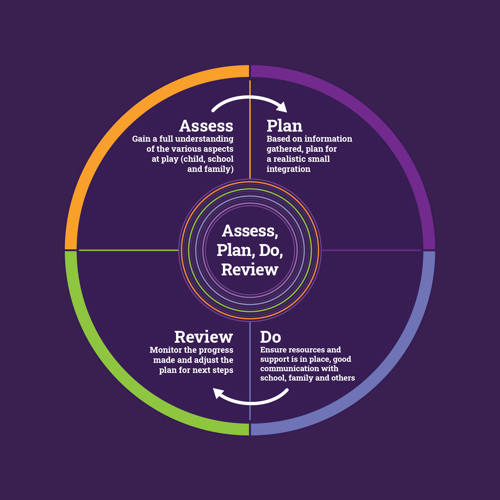
The graduated approach is a process that education settings use to identify, support, and review a child or young person's special educational needs. It is set out in the SEND Code of Practice and follows a four-stage cycle: Assess, Plan, Do, Review.

When working with children and young people experiencing EBSA, professionals can often note feeling uncertain about where to ‘start’. Arguably, the graduated approach can help professionals by providing a clear pathway for EBSA cases, it can also enable a team around a child to form whilst all working on clear goals. Children, young people and their families may also then have more clarity about the plan for their child and can feel contained by the process.

Assess

The ‘assess’ stage of the cycle should help professionals and families of a child or young person understand why they are struggling to attend school. This requires working closely with the young person and the application of person-centred ‘tools’ that enable a child to express their views:

• School Refusal Assessment Scale (Kearney & Silverman, 1993).
• School Wellbeing Cards/Card Sort (Holder, 2026)
• Landscape of Fear (Ripley, 2015)
• Creative activities to help the child express their feelings about school, e.g., use of collage, painting, clay.
• Use of person-centred view-finding tools, such as ‘Good Day / Bad Day’ activity (Sanderson, 2026)
• Use of ‘Children’s Exploratory Drawings’ (Timney & Cohman, 2020)
• Push/Pull factor model for EBSA / EBSNA
• The Iceberg Model to understand behaviour
The ‘assess’ stage should also involve working closely with the family, the education team, and any other support agencies involved. This should enable the gathering of important information, embed the importance of the ‘team’ around the child from the outset and offer space for problem-solving. Person-centred planning tools such as Planning Alternative Tomorrows with Hope (PATH) (Inclusive Teach) or Holistic Circles (Stanley-Duke, 2020). When engaging in this process, all views should be respected, and any differing viewpoints should be acknowledged; there are often multiple valid perspectives on nonattendance.
Psychologists can often support this stage as they can facilitate use of these tools with psychological expertise in mind. They can also utilise other tools such as the Revised Children’s Anxiety and Depression Scale (RCADS) or Resiliency Scales for Children and Adolescents (RSCA).
Overall, any resources used should aim to establish what the function(s) of school non-attendance is so a personalised plan can be created.

Plan

After the assessment, the team should create a plan collaboratively based on the function of non-attendance in the young person’s life.

An effective plan often includes the following:
• Home visits and regular telephone/face to face contact between parent and carers.
• All parties agree to SMART goals/actions and keep to them until the next review period. This involves each person having a role in what adaptations are going to be made; it should be clear who/what/where/when.
• A personalised programme for each young person. (e.g., flexible timetable, soft landings, buddying, incorporate interests). The plan must be mapped to the function of behaviour; for example, if they are expressing lack of friendships as a contributing factor, then the team could create an action plan that mediates positive relationships based on similar interests in school.
• Identifying a safe place in school that the young person can go to if needed. Ensuring the young person has access to an identified member of staff who can check in and review the ongoing actions.
• Effective communication - ensuring the education team are informed about the young person’s plan.
• Use of coping step plans and a ‘golden book’ to celebrate small, achievable targets and wins. It is important to note, however, that a coping step plan is unlikely to be as successful on its own. If anxiety is thought to have a strong influence on non-attendance, support should include helping a child understand their emotions.

Do

This stage involves acting on the plan. It is important to:

• Understand that reintegration / return to school should not be the first action established; children and young people need to feel that adults want to understand their whole life, not just focus on their attendance.
• Be well-prepared and stick to the plan so the young person can build trust in the process. It is important to act in a consistent and timely way. Try not to ‘move the goalposts’ or change a plan at the last minute. When a plan goes well, people can sometimes revert to withdrawing a plan, which can lead to more challenges. Try not to implement any changes without discussing them with the young person and their family.
• Expect this to be a slow process and celebrate effort, not outcome. Consider where the child might be in their ability to change, e.g., consult the ‘wheel of change’ model (Prochaska and DiClemente, 1986).
• Ensure communication throughout, especially with the young person and family, and with any other agencies involved.
• Be flexible and be prepared to move back a step if required.
• Welcome the child back into school and ensure they feel part of the community. Involving a young person in a community project where they can have an impact can support engagement.
• Try to ensure a ‘soft landing’ when a child comes into school; entry into school can often be a trigger point, so it is important to ‘catch’ them at this stage. Use of the ‘Share it, Shelf it, Shout it, Shed it’ framework in the morning can help a child express themselves and move through their day (See Pooky Knightsmith).
• Seek advice at any point if unsure of next steps.
• Try not to make assumptions about the young person’s ability. School-based anxiety is specific, and therefore it is often the case that a child can go out to other places whilst still experiencing anxiety related to school.

Review

When implementing a plan or intervention, it is essential to regularly evaluate and review progress:

• Offer ongoing opportunities for a young person to share their views and continually return to this.
• Use rating scales to monitor change.
• Cover any successes and progress made with the plan (however small) as well as whether any further information has been identified that may help to inform what happens next.
• Create a team ‘contract’, follow the plan and create regular SMART goals which can be reviewed – plan dates well in advance.
• Identify further outcomes or actions for the child, parents/carers and professionals involved.
• Identify any further consultation needed with external support agencies and any potential additional referral pathways.

EBSA is often complex and tricky to navigate. It is important to be patient, curious and compassionate when working with children experiencing this. Creating a supportive network around the child helps ensure that everyone contributes to and takes ownership of a plan. Most importantly, it conveys to the child that their wellbeing matters and that adults are seeking to understand their experiences, rather than focusing solely on school attendance.
Overall, it can be helpful to follow:
• Assessment phase - Focus on understanding the child’s views and the factors underpinning EBSA / EBSNA presentation.
• Planning phase - Formulate a plan based on information gathered, context of the child’s life and function of behaviour.
• Do phase - Ensure resources and support are implemented and are timely/consistent. Ensure there is good communication between school and family and that goalposts are not moved.
• Review phase - Monitor progress and adjust the plan accordingly.

References

• Prochaska, J. O., & DiClemente, C. C. (1986). Toward a comprehensive model of change. In Treating addictive behaviors: Processes of change (pp. 3-27). Boston, MA: Springer US.

• Thambirajah, M. S., Grandison, K. J., & De-Hayes, L. (2008). Understanding school refusal: A handbook for professionals in education, health and social care. Jessica Kingsley Publishers. DOI: https://doi. org/10.7748/mhp.12.3.22.s22

• Timney & Cohman (2020)., CEDs; http://theceds.co.uk/about/

• Kearney, C. A.; Silverman, W. K. (1993), Measuring the function of school refusal behavior: The School Refusal Assessment Scale", Journal of Clinical Child Psychology, 22 (1).

• Dr Jerricah Holder, School Wellbeing Cards/Card Sort., https://www.schoolwellbeingcards.co.uk/

• Kate Ripley (2015)., Autism from Diagnostic Pathway to Intervention: Checklists to Support Diagnosis, Analysis for Target-Setting and Effective Intervention Strategies

• Helen Sanderson, ‘Good Day, Bad Day resource’., https://www.helensandersonassociates.com/good-day-bad-day/

• Push/Pull factor model: https://www.twinkl.co.uk/resource/absa-ebsa-push-and-pull-factors-wl-cm-1749582681

• The Iceberg Model., https://calmandconnected.com.au/wp-content/uploads/2025/03/Behaviour-Iceberg_Handout_Calm-and-Connected.pdf

• Mary Stanley-Duke (2020)., Holistic circles – a visual representation of a child’s strengths and needs., https://edpsy.org.uk/features/2020/holistic-circles-representation-childs-strengths-needs/

• Pooky Knightsmith., https://www.pookyknightsmith.com/video-managing-worries-using-share-it-shelf-it-shout-it-shed-it/

• Inclusive Teach., https://inclusiveteach.com/2025/03/03/path-person-centered-planning/